Thursday, May 28, 2015

Space + Art

The topic of this week was space and art.  People have always looked up at the stars and wondered, but it wasn’t until the European Renaissance that science about the cosmos flourished.  Now fast forward to 1957 and the start of the space race, beginning with the launch of Sputnik (Vesna).  This triggered a back and forth between the United States and Russia with each side trying to one up the other.  The Russians sent the first humans to space, but the Americans were the first to land a human on the moon in 1969 (Vesna).  
Chesley Bonestell is thought of as an American pioneer of space art, and he pushed to mankind into space (“Bonestell”).  Perhaps without him, man would have never traveled to space! He also opened the door for many space artists today.  Additionally, there is still so much to be explored in space that an artist’s imagination has no limits on the topic.  
Saturn as seen from Titan, by Chesley Bonestell 1944
Space travel and research has entered more into the private sector as of recent years, and this may have influenced the creation of KSEVT.  KSEVT is a cultural center for space programs (“Cultural Space Programme”).  Many aspects of art have infiltrated space technologies, and KSEVT even had a theater performance in zero gravity!
Theater performance in zero gravity
Additional artists have used the influence of zero gravity.  One such artist is Benjamin Bergmann in his sculpture and performance piece Black Moon.  The work consists of a black helium balloon in an elevator during the day until it is released into the night sky.  This is symbolic of the existential freedom in the nothingness (Forde).  This piece is interesting because it uses the idea of space being vast and made mostly of nothing.  
Black Moon
With this brief introduction to the topic, it is clear to see the possibilities for art and space are endless and I believe that space art will only continue to grow as we learn more about what lies beyond Earth.  


References:
"Benjamin Bergmann." Art on Site. Web. 29 May 2015.  

"Bonestell." Bonestell - Home. Web. 29 May 2015.  

"Chesley Bonestell." Nova Space Art. Web. 29 May 2015.  

"Cultural Space Programme." KSEVT. Web. 29 May 2015.  

Forde, Kathleen. "Dancing on the Ceiling: Art & Zero Gravity." Dancing on the Ceiling: Art & Zero Gravity Curated by Kathleen Forde : EMPAC Curtis R. Priem Experimental Media and Performing Arts Center : Troy, NY USA. Web. 29 May 2015.  

Wednesday, May 20, 2015

Nanotechnology + Art


The topic of this week was focused on nanotechnology.  Like last week with neuroscience, we also know very little about this topic!  However, perhaps the fact that we know so little about nanotechnology leaves more room for artists and scientists to be creative.
Nanotechnology is all about the things that are very small.  In fact, the word “nano” comes from the Greek word for dwarf (Gimzewski).  These nanoparticles are so small new phenomena dominate over the traditional physics that we know such as gravity.  For reference, a meter is 10⁹ nanometers.  Nanotechnology opens up a lot of doors for new technologies, including but not limited to:  “bacteria that make gasoline; tiny devices that can repair individual cells, or even D.N.A.; gossamer threads, strong enough to hold up a bridge; or an elevator to the stars” ("Making Stuff Smaller”).  Currently, nanotechnology has helped to make blood clots visible in order to combat cardiovascular disease, America’s number one killer (“New Nanoparticles Make Blood Clots Visible”).  There is so much potential in the things we cannot see!  But there are also downfalls to nanoparticles.  Some pollution nanoparticles have been shown to damage the respiratory tract  ("Findings on Pollution Damage”). 
Geckos use nanotechnology in their feet to climb.  
Nanoparticles are nothing new, but rather they are something we had never thought of before.  For instance, the nanostructure of gecko feet allows them to climb (Gimzewski).  Also, a piece of ancient Roman pottery looks vastly different in different lighting due to nanoparticles ("The Lycurgus Cup”).  
The Lycurgus Cup in daylight (left) and illuminated from the inside (right).  
Nanotechnology and art also exists today.  Professor Vesna has a piece entitled “Nanomandala.”  The work uses a scanning electron microscope to eventually reveal an image of a mandala.       
Nanomandala.  
Only time will tell what the future holds in store for nanotechnology.  


References:
Curtin, Jon. "Art in the Age of Nanotechnology." Art.base. Web. 21 May 2015.  
"Findings on Pollution Damage." 1 Feb. 2011. Web. 21 May 2015.  
"Making Stuff Smaller." PBS. PBS. Web. 21 May 2015.  
"New Nanoparticles Make Blood Clots Visible." Tracking Nanotechnology. 7 Feb. 2011. Web. 21 May 2015.  
"Programmable Bio-Nano-Chip as Medical Diagnostic Tool." NanoWiki. Web. 21 May 2015.  

"The Lycurgus Cup." British Museum -. Web. 21 May 2015.  

Saturday, May 16, 2015

Neuroscience + Art

The topic we learned about this week was neuroscience and art.  Neuroscience is still a field where we have so much to learn.  However, we have advanced pretty far relative to the days of Aristotle when he thought all of the thinking was done in the heart (Vesna).  After it was discovered that thinking occurs in the brain, Franz Joseph Gall came up with the idea of phrenology, which describes that mental functions are dependent on skull shape (“The History of Phrenology”).  This proved to be incorrect, but Gall was correct that different areas of the brain have different functions.  Today there are still many research topics in neuroscience, including one study that says mediation can help to build grey matter (Wheeler).

Areas of the skull in phrenology.
The brain and all of its neurons is a beautiful piece of art.  Two men, Golgi and Ramon y Cajal, were pioneers in figuring out the shapes of neurons in the brain (Vesna).  Interestingly, Ramon y Cajal also had aspirations to be an artist and his neuroanatomy drawings are still used in textbooks today.  Neurons have inspired artwork today with individual neurons marked with fluorescent proteins.  The resulting images are beautiful pieces of art with each neuron distinguished from one another with bright colors. 

Brainbow. 

Consciousness and dreams are another major aspect of neuroscience that we know very little about.  In fact, it is estimated that 95 percent of dreams are forgotten (Vesna).  Sigmund Freud and Carl Jung thought a lot about the topic of consciousness.  Jung thought of the modern man as being “newly formed” and “fully conscious of the present.”  Additionally in this time, many artists and scientists alike were experimenting with drugs such as LSD and cocaine.  These drugs aided in a counterculture that was able to experience a consciousness very unlike the present (Markel).  Science may not be able to fully comprehend this yet, but until then, we will have art to depict it. 


Depiction of what it is like on LSD. 


References:
"Brainbow." Harvard Center for Brain Science. Web. 17 May 2015.

Jung, C. G. The Spiritual Problem of Modern Man. Print.

Markel, Howard. "Sigmund Freud's Cocaine Problem." CNN. Web. 16 May 2015.

"The History of Phrenology." The History of Phrenology. Web. 16 May 2015.


Wheeler, Mark. "How to Build a Bigger Brain." How to Build a Bigger Brain. 12 Mar. 2009. Web. 16 May 2015.

Sunday, May 10, 2015

Biotech + Art

            This week we explored the topic of biotechnology and art.  This has turned out to be a very controversial field with some artists believing that they must work directly with live tissues in order to create art.  The ethical debate continues as the artists are pushing the limits of human creativity by creating new organisms by ways of highly modifying existing organisms.  In her essay “Defining Life: Artists Challenge Conventional Classifications,” Ellen Levy writes, “life forms produced through genetic engineering are necessarily a mix of nature and culture.”  Thus, biotech art falls in a realm between what we consider natural and what our culture produces.  Despite many controversies, biotech is still very popular. 
            In his TED Talk, Barry Schuler suggests that we have always modified genomes and that we wouldn’t even have wine if we did not do so.  Schuler also quoted James Watson’s famous line, “If we don’t play God, who will?”  Modifying genomes was alos the topic of Jurassic Park, where the scientists bring dinosaurs back to life.  So along these lines, why not also modify biology for the sake of art?

Jurassic Park 
            Using biotechnology for the sake of art is the goal of the group SymbioticA.  SymbioticA was established in 2000 and based out of the University of Western Australia.  It is a wet laboratory for art in the life sciences.  Kathy High was a resident at SymbioticA, and she has had many notable works in the biotech art field.  One of which is entitled Blood Wars.  This project consisted of taking human red blood cells and having them fight pathogens in petri dishes.  Another one of High’s notable pieces is her photo series on transgenic rats, HLA-B27. 
HLA-B27
            Ultimately, from this look at biotech and art, there seems to be no limit to human creativity; however, the ethical debate on the topic may never cease. 

Blood Wars.

References:

"Barry Schuler: Genomics 101." TED. 1 June 2008. Web. 11 May 2015.

High, Kathy. "Embracinganimal.com." Embracing Animal. Web. 11 May 2015.

"Jurassic Park." Swank Motion Pictures, Inc. Web. 11 May 2015.

"Kathy High: Visual/media Artist, Independent Curator, Educator." Kathy High. Web. 11 May 2015.


"SymbioticA." The University of Western Australia. Web. 11 May 2015.

Thursday, April 23, 2015

Medicine + Tehnology + Art

            This week we looked at medicine, technology, and art.  Being a physiological science major, this topic particularly peaked my interest. 
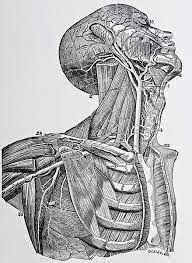
            The human body has always been a major part of art, particularly during the Renaissance period when people began to experiment with human dissection (Bambach 2000).  Then in 1858, Henry Gray published Anatomy, and the book has been commonplace on the shelves of artists and physicians alike. 


An illustration from Gray’s Anatomy.
https://www.rcseng.ac.uk/museums/hunterian/exhibitions/archive/150-years-of-gray2019s-anatomy

            New technologies in plastic surgery following World War One resulted in an increase in popularity.  Society has become fascinated by it as expressed by the popularity of the television drama Nip/Tuck and the reality series Dr. 90210.  In many ways, the plastic surgeons themselves are exhibiting the connection between medicine and art by trying to create something beautiful through their work as a medical professional.  Additionally, the artist French Orlan has plastic surgeries performed on her for her artwork.  She has undergone operations in order to “to transform herself into a new being, modeled on Venus, Diana, Europa, Psyche and Mona Lisa” (Pescarmona 2003). 

The artist Orlan.
http://www.ienhance.com/articles/the-weird-science-of-plastic-surgery-art-introducing-artist-orlan

            Eduardo Kac is a Brazilian artist interested in many disciplines of bio art.  One of his notable works is the GFP Bunny, which was the successful breeding of a rabbit with green fluorescent protein giving the animal a green glow (Plohman 2000).  Like Orlan before him, the science is part of the artwork itself.  He hoped the art of his rabbit would force people to become aware of biotechnology.      

GFP Bunny.
www.ekac.org/gfpbunny.html
 As illustrated by these examples, medicine, technology, and art can literally be linked. 

References:


"About Dr. Rey." Dr. Robert Rey. Web. 23 Apr. 2015. <http://www.drrobertrey.com/pages/about.html>.

Bambach, Carmen. "Anatomy in the Renaissance". In Heilbrunn Timeline of Art History. New York: The Metropolitan Museum of Art, 2000. http://www.metmuseum.org/toah/hd/anat/hd_anat.htm

"BIO ART." KAC. Web. 23 Apr. 2015. <http://www.ekac.org/transgenicindex.html>.

Pescarmona, Denee. "Who Is Orlan?" UCSB English. 1 Jan. 2003. Web. 24 Apr. 2015. <http://oldsite.english.ucsb.edu/faculty/ecook/courses/eng114em/whoisorlan.htm>.


Plohman, Angela. "Eduardo Kac." Daniel Langlois Foundation. 1 Jan. 2000. Web. 23 Apr. 2015. <http://www.fondation-langlois.org/html/e/page.php?NumPage=279>.