Sunday, May 10, 2015

Biotech + Art

            This week we explored the topic of biotechnology and art.  This has turned out to be a very controversial field with some artists believing that they must work directly with live tissues in order to create art.  The ethical debate continues as the artists are pushing the limits of human creativity by creating new organisms by ways of highly modifying existing organisms.  In her essay “Defining Life: Artists Challenge Conventional Classifications,” Ellen Levy writes, “life forms produced through genetic engineering are necessarily a mix of nature and culture.”  Thus, biotech art falls in a realm between what we consider natural and what our culture produces.  Despite many controversies, biotech is still very popular. 
            In his TED Talk, Barry Schuler suggests that we have always modified genomes and that we wouldn’t even have wine if we did not do so.  Schuler also quoted James Watson’s famous line, “If we don’t play God, who will?”  Modifying genomes was alos the topic of Jurassic Park, where the scientists bring dinosaurs back to life.  So along these lines, why not also modify biology for the sake of art?

Jurassic Park 
            Using biotechnology for the sake of art is the goal of the group SymbioticA.  SymbioticA was established in 2000 and based out of the University of Western Australia.  It is a wet laboratory for art in the life sciences.  Kathy High was a resident at SymbioticA, and she has had many notable works in the biotech art field.  One of which is entitled Blood Wars.  This project consisted of taking human red blood cells and having them fight pathogens in petri dishes.  Another one of High’s notable pieces is her photo series on transgenic rats, HLA-B27. 
HLA-B27
            Ultimately, from this look at biotech and art, there seems to be no limit to human creativity; however, the ethical debate on the topic may never cease. 

Blood Wars.

References:

"Barry Schuler: Genomics 101." TED. 1 June 2008. Web. 11 May 2015.

High, Kathy. "Embracinganimal.com." Embracing Animal. Web. 11 May 2015.

"Jurassic Park." Swank Motion Pictures, Inc. Web. 11 May 2015.

"Kathy High: Visual/media Artist, Independent Curator, Educator." Kathy High. Web. 11 May 2015.


"SymbioticA." The University of Western Australia. Web. 11 May 2015.

Thursday, April 23, 2015

Medicine + Tehnology + Art

            This week we looked at medicine, technology, and art.  Being a physiological science major, this topic particularly peaked my interest. 
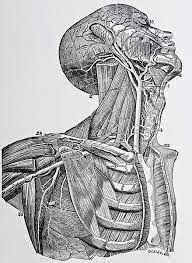
            The human body has always been a major part of art, particularly during the Renaissance period when people began to experiment with human dissection (Bambach 2000).  Then in 1858, Henry Gray published Anatomy, and the book has been commonplace on the shelves of artists and physicians alike. 


An illustration from Gray’s Anatomy.
https://www.rcseng.ac.uk/museums/hunterian/exhibitions/archive/150-years-of-gray2019s-anatomy

            New technologies in plastic surgery following World War One resulted in an increase in popularity.  Society has become fascinated by it as expressed by the popularity of the television drama Nip/Tuck and the reality series Dr. 90210.  In many ways, the plastic surgeons themselves are exhibiting the connection between medicine and art by trying to create something beautiful through their work as a medical professional.  Additionally, the artist French Orlan has plastic surgeries performed on her for her artwork.  She has undergone operations in order to “to transform herself into a new being, modeled on Venus, Diana, Europa, Psyche and Mona Lisa” (Pescarmona 2003). 

The artist Orlan.
http://www.ienhance.com/articles/the-weird-science-of-plastic-surgery-art-introducing-artist-orlan

            Eduardo Kac is a Brazilian artist interested in many disciplines of bio art.  One of his notable works is the GFP Bunny, which was the successful breeding of a rabbit with green fluorescent protein giving the animal a green glow (Plohman 2000).  Like Orlan before him, the science is part of the artwork itself.  He hoped the art of his rabbit would force people to become aware of biotechnology.      

GFP Bunny.
www.ekac.org/gfpbunny.html
 As illustrated by these examples, medicine, technology, and art can literally be linked. 

References:


"About Dr. Rey." Dr. Robert Rey. Web. 23 Apr. 2015. <http://www.drrobertrey.com/pages/about.html>.

Bambach, Carmen. "Anatomy in the Renaissance". In Heilbrunn Timeline of Art History. New York: The Metropolitan Museum of Art, 2000. http://www.metmuseum.org/toah/hd/anat/hd_anat.htm

"BIO ART." KAC. Web. 23 Apr. 2015. <http://www.ekac.org/transgenicindex.html>.

Pescarmona, Denee. "Who Is Orlan?" UCSB English. 1 Jan. 2003. Web. 24 Apr. 2015. <http://oldsite.english.ucsb.edu/faculty/ecook/courses/eng114em/whoisorlan.htm>.


Plohman, Angela. "Eduardo Kac." Daniel Langlois Foundation. 1 Jan. 2000. Web. 23 Apr. 2015. <http://www.fondation-langlois.org/html/e/page.php?NumPage=279>.

Sunday, April 19, 2015

Robotics + Art

                  This week I will be discussing the topic of robotics and art.  Karel Capek was the first to coin the term “robot,” which comes from robota meaning work.  We see the idea of robotics start to creep up along with the advent of the assembly line at Ford Automobiles.  The workers of the assembly line were treated like parts of a machine, as depicted in Charlie Chaplin’s Modern Times, and from here, we start to see how the idea of robots to do our work came about (Pontefract 2015).

Charlie Chaplin as part of a machine in Modern Times.
http://tvtropes.org/pmwiki/pmwiki.php/Film/ModernTimes

                  With the advancement of technology, some people react negatively.  For instance in the realm of art, quality may be sacrificed in favor of quantity (Benjamin 1936).  Negative reactions to industrialization are also depicted in film.  The robot movie of 2004, I, Robot, depicts this divide with Will Smith’s character having an anti-robot view and the rest of society uses robots for daily life (Scott 2004).  Turns out, Smith had the right to be skeptical when the robots have a plot against humans, which is quite an advancement from the Turing machine, created by the father of artificial intelligence, Alan Turing (James 2013). 

Will Smith in I, Robot.
http://scalar.usc.edu/works/kevintoghiairobot/index


                  However, society doesn’t always respond negatively, and some artists have embraced industrialization and technology.  Ken Rinaldo is one such artist.  His work is inspired by the “intersection between natural and technological systems” (Rinaldo 2004).  Enteric Consciousness, by Rinaldo, depicts a robotic tongue (complete with artificial stomach), a bowl of chocolate, and a dopamine molecule model.  Rinaldo is exploring the idea of the conscious stomach by embracing the technology of his art and the biology behind the piece. 

Enteric Consciousness
http://www.ediblegeography.com/gut-control/


References:

Benjamin, Walter. The Work of Art in the Age of Mechanical Reproduction. 1936.

James, Mike. "What Is a Turing Machine?" What Is a Turing Machine? 14 Jun. 2013. Web. 19 Apr. 2015. <http://www.i-programmer.info/babbages-bag/23-turing-machines.html>.

"Ken Rinaldo | Interactive Installation Intersecting Organic and Technological Cultures." Ken Rinaldo | Interactive Installation Intersecting Organic and Technological Cultures. Web. 19 Apr. 2015. <http://kenrinaldo.com/index.html>.

Rinaldo, Ken. "Ken Rinaldo - Robotic Sculpture, Interactive Art Inspired by Natural Systems."Ken Rinaldo - Robotic Sculpture, Interactive Art Inspired by Natural Systems. 1 Jan. 2004. Web. 19 Apr. 2015. <http://www.ylem.org/artists/krinaldo/>.

Pontefract, Dan. "What CIOs Can Learn From Charlie Chaplin's Film 'Modern Times'" Forbes. Forbes Magazine, 15 Apr. 2015. Web. 19 Apr. 2015. <http://www.forbes.com/sites/danpontefract/2015/04/15/what-cios-can-learn-from-charlie-chaplins-film-modern-times/>.


Scott, A.O. "I Robot (2004) FILM REVIEW; The Doodads Are Restless." New York Times 17 July 2004. Web.

Sunday, April 12, 2015

Math + Art

            This week we looked into the relationship of mathematics and art.  As it turns out, mathematics has greatly influenced art and science.  For instance, Linda Henderson describes how art began to change following Einstein’s theories, particularly the fourth dimension.  The fourth dimension encouraged the artists to depart from visual reality and into something new, and motion became an important aspect of art.  Edwin Abbott also explores mathematics and art when he describes the penny on the table example and how changing mathematical angles can alter perspective. 

An example of the fourth dimension in art, Pablo Picasso’s Portrait of Daniel-Henry Kahnweiler. 

            Nathan Selikoff is self-described as a “fine artist playing at the intersection of interactivity, math, and art.”  He uses math in his art and exemplifies the influence of math on art.   Like artists before him, he was inspired by the fourth dimension and has a work entitled Four Dimensions, which exhibits the four mathematical dimensions.  He also has a work to explore the beauty in mathematical equations entitled Beautiful Chaos.  Selikoff completely links mathematics and art in his work. 


A still image from Beautiful Chaos. 
http://nathanselikoff.com/works/beautiful-chaos

            On the surface mathematics and art may seem to be a juxtaposed concept, but in reality, we see that the two are intertwined.  Let’s take the origami of Robert Lang, for example.  Lang explains how very complex origami can be attributed to mathematical principles.  So, he is applying mathematical principles in order to make something beautiful.  Additionally, he goes on to explain how things originally intended for aesthetics end up having applications, such as the medical stent or folding telescope.  Thus, math and art may not be as separate as we once believed. 


Origami heart stent prototype.

 References: 
Abbott, Edwin Abbott. Flatland a Romance of Many Dimensions. Champaign, Ill.: Project Gutenberg, 1884.

Henderson, Linda. "The Fourth Dimension and Non-Euclidean Geometry in Modern Art: Conclusion." Leonardo 17.3 (1984): 205-10.

"Nathan Selikoff Art & Algorithms / A Digital Arts Festival October 5-11, 2015 Titusville, FL."Art Algorithms A Digital Arts Festival October 511 2015 Titusville FL. Web. 13 Apr. 2015. <http://artandalgorithms.com/artists/nathan-selikoff/>.

"Nathan Selikoff | Fine Artist Playing with Interactivity, Math, Code." Nathan Selikoff. Web. 13 Apr. 2015. <http://nathanselikoff.com/>.


"The Math and Magic of Origami." Robert Lang:. Web. 13 Apr. 2015. <http://www.ted.com/talks/robert_lang_folds_way_new_origami>.